Sorry, this entry is only available in Español.
LED Technology in Sport Management

The advances and expansion of LED technology over the last two centuries are indisputable. Thus, we have gone from a sporadic presence that was limited to very specific areas of the more industrialised countries in the 20th century to, in just one century, a very marked preponderance in Europe, United States, South-east Asia and some areas of Latin America and Oceania.
Such success has been possible, above all, to the large number of advantages of LED screens for different uses, areas and sectors. This is especially clear in the world of sport, where they have become a generational takeover from traditional sports scoreboards.
We highlight some of the advantages of LED screens in the area of sport below:
– Versatility: many different applications (scoreboard, repetitions, communication/information, live events, television…)
– Profitability: fast amortisation thanks to the income from advertising; this is one of the most profitable advertising means with fast return on investment.
– Excellent visibility: even the smaller sized screens permit the display of tall digits, which can be seen from even the more distant seats.
– Easy assembly and installation: thanks to its weight, simple control system and matrix modularity; this product is totally configurable, extendable and adaptable.
– Moderate electrical consumption: this is achieved thanks to the use of high efficiency and high performance LEDs, and to the electronic automatic luminosity control system.
– Resistance and long working life: both the screens and the control electronics are exclusively made up of high range LEDs and components.
Furthermore, thanks to the LED sport screens, the spectators’ experience is more complete, as they enable live broadcasts to be offered, as well as the repetition of the most spectacular or controversial plays, and all kinds of information in real time.
A whole world of possibilities that the R&D&I Director of Mondo Iberica, Ignacio Mercado, brought to the table during the Aragonese Symposium on Management in Sport 2014, organised by GEDA Aragon. The Symposium took place on 23 and 24 October and its objective was to reflect upon this topic and find answers to the difficulties and challenges that emerge in the daily activity of sport directors, providing them with decision-making tools.
The Nobel Prize awarded to LED technology

Energy saving and the fantastic possibilities that LED technology has brought to our lives had to receive recognition. And it has done so in the best possible way, in the form of a Nobel Prize.
Hiroshi Amano, Shuji Nakamura and Isamu Akasaki, the three Japanese researchers, considered to be the fathers of blue LED, were awarded the 2014 Nobel Prize in Physics at the beginning of this month for their great contribution to LED technology.
In this sense, it is important to highlight that, before the discovery made by these three physicians, LED technology was “incomplete” and with limited potential. Both red and green LEDs already existed, but without the blue ones, it was impossible to produce white light based on LED technology.
Thanks to the discovery of Amano, Nakamura and Akasaki, which had already been pursued by many researchers in previous decades, LED technology was able to reach its full application potential to daily life, displacing traditional light bulbs in energy products.
And, much more than that, as LED technology has currently added numerous applications, permitting, in all cases, considerable energy saving. From light bulbs to LED screens, as well as traffic lights, urban lighting and mobile phones… today LED technology is an essential part of our lives.
Draws, kiss cams, charitable causes, advertising… Video-scoreboards that bring basketball to life
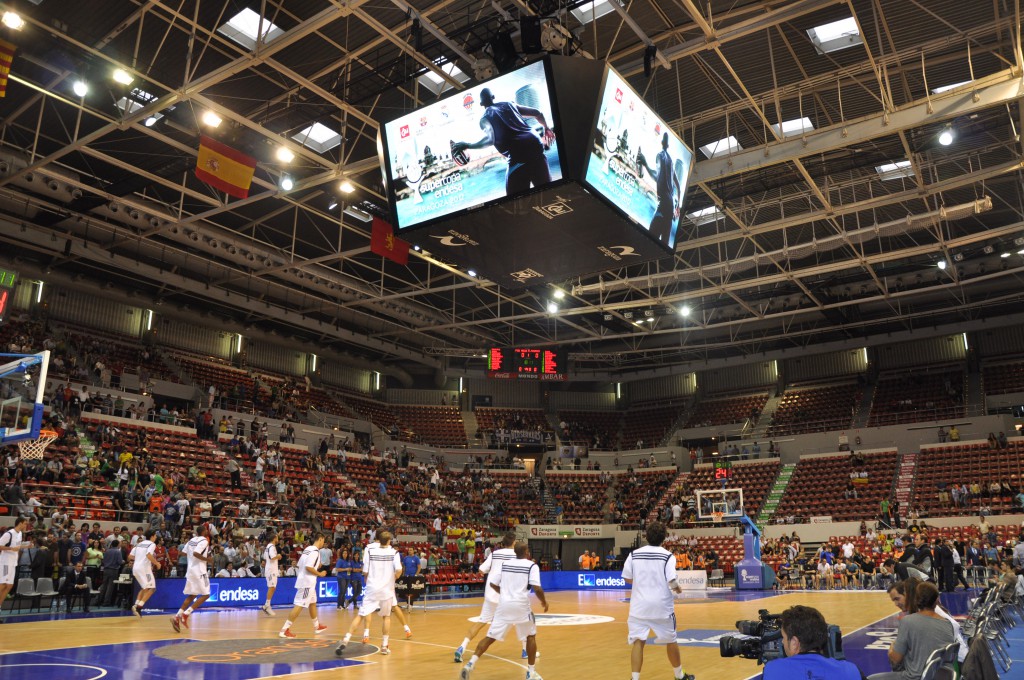
The arrival of interactive video scoreboards has revolutionised the Endesa league, giving spectators the chance to have a much fuller experience.
Over the last few years, clubs as important as Real Madrid, Barcelona, Estudiantes, Laboral Kutxa, Bilbao Basket, Unicaja Malaga and CAI Zaragoza have installed the latest technology in LED screens in their pavilions, thus providing an added value.
The number of possibilities is unimaginable. The more “basic” ones involve using the video scoreboard for replays, to offer results from other pavilions in real time, to wish their fans a happy birthday or to advertise initiatives the club takes part in. But there is a lot more. Why not let those clubs that have known how to make the most of the potential of this LED technology tell us about it.
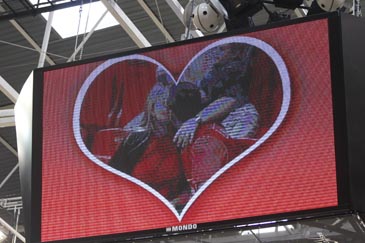
CAI Zaragoza, for example, has adopted a very American tradition: The kiss cam. During half-time, it selects a couple out of those attending the match, who have to kiss each other in front of all the fans.
With their video scoreboard, Laboral Kutxa broadcast the second half of the decisive match between Deportivo Alavés and Numancia live, when the former were playing to remain in the Second Division. Fans were able to watch it on the big screen before the quarter-final match of the King’s Cup between Laboral Kutxa and Barcelona.
Bilbao Basket shows the most charitable side with its initiative “One match, one cause”. Each match introduces a Basque social entity, using the LED screen as visual support.
Unicaja Malaga’s commitments are more recreational, going from adapting the graphics of the video scoreboard to special dates such as Christmas to the use of its overhead camera to choose the winner of its Halloween fancy dress contest, or to show the video clip of its anthem for the first time.
But it is Estudiantes that use it more interactively as, before each match, they publish a selection of the best photographs posted by ‘Demencia’ in their Instagram account. The Madrid club also uses the video scoreboard to publish the winners of their photography contests and, in short, to improve and increase the connection with their fans.
Is there still anybody who believes that LED technology gives nothing to sport?