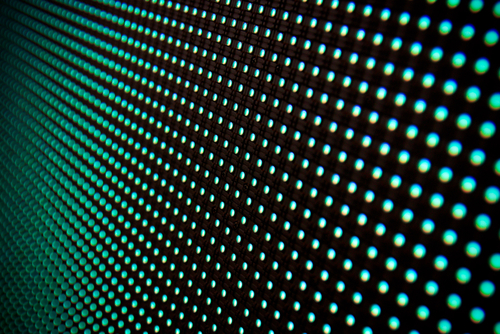
Over the last 20 years, the evolution of large format LED screens has been incessant. Since the first LED screens to the current giant screens, which permit broadcasting images in high-definition (HD), the changes and improvements in LED bulb technology have led to a more than significant quality.
At the beginning of the 90s, the first screens comprised of LEDs had 16 and 256 colours and the pixel separation was so big that their function was limited to the reproduction of simple animations, never a clear image or with optimal resolution quality.
With the arrival of the new century and the evolution of the efficiency of the LED bulbs that form the pixels, the giant LED screens and their quality improved significantly with respect to the screens from the previous decade. In the year 2000, 16 million colours were reached and therefore the possibility of giving support to broadcasting videos with a higher quality than that offered by the first LED screens in the 90s.
The reduction of the pixel size and, thus, the possibility of increasing their number per square metre, is the main objective of manufacturers to increase the resolution quality of the image. In the mid-2000s, the LED bulb technology achieved was able to reproduce more than 4 trillion colours, which permitted configuring tailor-made LED screens with a greater pitch (density of pixels per square metre) than their predecessors, which resulted in an increase in the image resolution.
Currently, LED technology has managed to develop and combine the virtual pixel with the real pixel and, therefore, increase the resolution of the image, being able to broadcast video in HD quality. Other factors that have led to the increase in image quality of LED screens today have been the improvements in resolution and pitch, the new types of LED bulbs such as the SMD or Through Hole or the feat of having managed to reproduce 281 trillion colours. Furthermore, these advances have permitted the creation of customised giant LED screens according to the client’s needs.